| 1.5 | Inverse Functions |
 |
|
|
|||||||||||||||||||||||
The Inverse Problem
The concept of an inverse function will play a key role in this book in defining roots, logarithms, and inverse trigonometric
functions. To motivate this concept, we begin with some simple examples.
Suppose  is the function defined by
  . Given a value of
  , we can find the value of
  by using the formula defining . For example, taking
  , we see that
  equals
  .
.
is the function defined by . Given a value of , we can find the value of by using the formula defining . For example, taking , we see that equals .
In the inverse problem, we are given the value of and asked to find the value of . The following example illustrates the idea of the inverse problem:
and asked to find the value of . The following example illustrates the idea of the inverse problem:
|
||||||||||||||||||||||||||||

 .
.
 .
.
 for
for  .
.
 for
for  .
.
 for
for  .
.
For each number  , part (c) of the example above asks for the number such that
  . That number is called
  (pronounced “ inverse of ”). The example above shows that if , then
  and
and 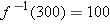 and, more generally,
  for every number .
, part (c) of the example above asks for the number such that . That number is called (pronounced “ inverse of ”). The example above shows that if , then and and, more generally, for every number .
|
|
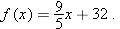
To see how inverse functions can arise in real-world problems, suppose you know that a temperature of degrees Celsius corresponds to  degrees Fahrenheit (we will derive this formula in Example 5 in Section 2.1). In other words, you know that the function
that converts the Celsius temperature scale to the Fahrenheit temperature scale is given by the formula
degrees Fahrenheit (we will derive this formula in Example 5 in Section 2.1). In other words, you know that the function
that converts the Celsius temperature scale to the Fahrenheit temperature scale is given by the formula
degrees Celsius corresponds to degrees Fahrenheit (we will derive this formula in Example 5 in Section 2.1). In other words, you know that the function
that converts the Celsius temperature scale to the Fahrenheit temperature scale is given by the formula
|
|
|
 , this formula shows that
  degrees Celsius corresponds to
  degrees Fahrenheit.
If you are given a temperature on the Fahrenheit scale and asked to convert it to Celsius, then you are facing the problem
of finding the inverse of the function above, as shown in the following example.
|
||||||||||||||||||||||||||||||||
 degrees Fahrenheit to the Celsius scale.
 century by the German physicist and engineer Daniel Gabriel Fahrenheit.
 as the boiling point of water and
  as the freezing point. Later this was reversed, giving us the familiar scale in which higher numbers correspond to hotter
temperatures.
as the freezing point. Later this was reversed, giving us the familiar scale in which higher numbers correspond to hotter
temperatures.
 . Solving the equation
  for
for  . Thus
  degrees Celsius corresponds to
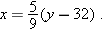
 degrees Celsius corresponds to
 In the example above we have 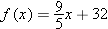 . For each number , part (b) of the example above asks for the number such that . We call that number . Part (a) of the example above shows that
  ; part (b) shows more generally that
In this example, the function converts from Celsius to Fahrenheit, and the function  goes in the other direction, converting from Fahrenheit to Celsius.
. For each number , part (b) of the example above asks for the number such that . We call that number . Part (a) of the example above shows that ; part (b) shows more generally that
|
 converts from Celsius to Fahrenheit, and the function goes in the other direction, converting from Fahrenheit to Celsius.
One-to-one Functions
To see the difficulties that can arise with inverse problems, consider the function , with domain the set of real numbers, defined by the formula
Suppose we are told that is a number such that  , and we are asked to find the value of . Of course
  , but also
  . Thus with the information given we have no way to determine a unique value of such that . Hence in this case an inverse function does not exist.
, with domain the set of real numbers, defined by the formula
|
 is a number such that , and we are asked to find the value of . Of course , but also . Thus with the information given we have no way to determine a unique value of such that . Hence in this case an inverse function does not exist.
The difficulty with the lack of a unique solution to an inverse problem can often be fixed by changing the domain. For example,
consider the function  , with domain the set of positive numbers, defined by the formula
Note that is defined by the same formula as in the previous paragraph, but these two functions are not the same because they have different domains. Now if we are told
that is a number in the domain of such that  and we are asked to find , we can assert that
  . More generally, given any positive number , we can ask for the number in the domain of such that
  . This number , which depends on , is denoted
  , and is given by the formula
, with domain the set of positive numbers, defined by the formula
|
 is defined by the same formula as in the previous paragraph, but these two functions are not the same because they have different domains. Now if we are told
that is a number in the domain of such that and we are asked to find , we can assert that . More generally, given any positive number , we can ask for the number in the domain of such that . This number , which depends on , is denoted , and is given by the formula
is defined by the same formula as in the previous paragraph, but these two functions are not the same because they have different domains. Now if we are told
that is a number in the domain of such that and we are asked to find , we can assert that . More generally, given any positive number , we can ask for the number in the domain of such that . This number , which depends on , is denoted , and is given by the formula
|

We saw earlier that the function defined by  (and with domain equal to the set of real numbers) does not have an inverse because, in particular, the equation has more than one solution. A function is called one-to-one if this situation does not arise.
defined by (and with domain equal to the set of real numbers) does not have an inverse because, in particular, the equation has more than one solution. A function is called one-to-one if this situation does not arise.
|
For example, the function , with domain the set of real numbers, defined by is not one-to-one because there are two distinct numbers in the domain of such that (we could have used any positive number instead of  to show that is not one-to-one). In contrast, the function , with domain the set of positive numbers, defined by
  is one-to-one.
, with domain the set of real numbers, defined by is not one-to-one because there are two distinct numbers in the domain of such that (we could have used any positive number instead of to show that is not one-to-one). In contrast, the function , with domain the set of positive numbers, defined by is one-to-one.
The Definition of an Inverse Function
We are now ready to give the formal definition of an inverse function.
|
||||||||||||||||||||
|
||||||||||||||||||||||||
 .
.
 .
.
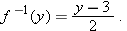
 . In other words, we must solve the equation
  . The solution to this equation is
  , and hence
  .
.

 . Thus
  , and hence

If is a one-to-one function, then for each in the range of we have a uniquely defined number . Thus is itself a function.
is a one-to-one function, then for each in the range of we have a uniquely defined number . Thus is itself a function.
|
|
Think of as undoing whatever does. This list gives some examples of a function and its inverse .
as undoing whatever does. This list gives some examples of a function and its inverse .
|

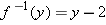


The first entry in the list above shows that if is the function that adds  to a number, then is the function that subtracts from a number.
is the function that adds to a number, then is the function that subtracts from a number.
The second entry in the list above shows that if is the function that multiplies a number by  , then is the function that divides a number by .
is the function that multiplies a number by , then is the function that divides a number by .
Similarly, the third entry in the list above shows that if is the function that squares a number, then is the function that takes the square root of a number (here the domain of is assumed to be the nonnegative numbers, so that we have a one-to-one function).
is the function that squares a number, then is the function that takes the square root of a number (here the domain of is assumed to be the nonnegative numbers, so that we have a one-to-one function).
Finally, the fourth entry in the list above shows that if is the function that takes the square root of a number, then is the function that squares a number (here the domain of is assumed to be the nonnegative numbers, because the square root of a negative number is not defined as a real number).
is the function that takes the square root of a number, then is the function that squares a number (here the domain of is assumed to be the nonnegative numbers, because the square root of a negative number is not defined as a real number).
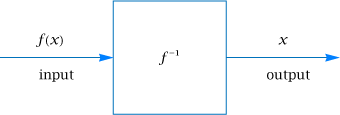
In Section 1.1 we saw that a function can be thought of as a machine that takes an input and produces an output . Similarly, we can think of as a machine that takes an input and produces an output .
can be thought of as a machine that takes an input and produces an output . Similarly, we can think of as a machine that takes an input and produces an output .
|
|
|

The procedure for finding a formula for an inverse function can be described as follows:
|
|
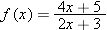
 . Find a formula for
 , getting



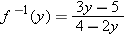
 .
.
 has no solution (try to solve it to see why), and thus
  is not defined.
The Domain and Range of an Inverse Function
The domain and range of a one-to-one function are nicely related to the domain and range of its inverse. To understand this
relationship, consider a one-to-one function . Note that is defined precisely when is in the range of . Thus the domain of equals the range of .
. Note that is defined precisely when is in the range of . Thus the domain of equals the range of .
Similarly, because reverses the action of , a moment's thought shows that the range of equals the domain of . We can summarize the relationship between the domains and ranges of functions and their inverses as follows:
reverses the action of , a moment's thought shows that the range of equals the domain of . We can summarize the relationship between the domains and ranges of functions and their inverses as follows:
|
||||||||||||||
|
|||||||||||||||||||||||||||||||||||
 , with
  because that interval is equal to the set of squares of numbers in the interval
  for
for  . In other words,
 The Composition of a Function and Its Inverse
The following example will help motivate our next result.
|
 .
.
 .
.
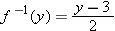 . Thus we have the following:


Similar equations hold for the composition of any one-to-one function and its inverse:
|
||||||||||||||
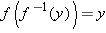 for every
 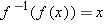 for every
 To see why these results hold, first suppose is a number in the range of . Let  . Then . Thus
as claimed above.
is a number in the range of . Let . Then . Thus
|

To verify the second conclusion in the box above, suppose is a number in the domain of . Let  . Then
  . Thus
as claimed.
is a number in the domain of . Let . Then . Thus
|

Recall that  is the identity function defined by
  (where we have left the domain vague), or we could equally well define by the equation
  . The results in the box above could be expressed by the equations
Here the in the first equation above has domain equal to the range of (which equals the domain of ), and the in the second equation above has the same domain as . The equations above explain why the terminology “inverse” is used for the inverse function: is the inverse of under composition in the sense that the composition of and in either order gives the identity function.
is the identity function defined by (where we have left the domain vague), or we could equally well define by the equation . The results in the box above could be expressed by the equations
|
 in the first equation above has domain equal to the range of (which equals the domain of ), and the in the second equation above has the same domain as . The equations above explain why the terminology “inverse” is used for the inverse function: is the inverse of under composition in the sense that the composition of and in either order gives the identity function.
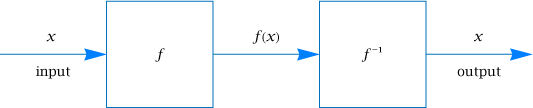
The figure below illustrates the equation  , thinking of and as machines.
, thinking of and as machines.
|
|
|
|
|
We start with
 as the input. The first machine produces output as the input. The first machine produces output  , which then becomes the input for the second machine. When is input into the second machine, the output is because the second machine, which is based on , which then becomes the input for the second machine. When is input into the second machine, the output is because the second machine, which is based on  , reverses the action of , reverses the action of  . .
|
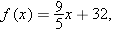
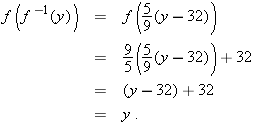
Suppose you need to compute the inverse of a function . As discussed earlier, to find a formula for you need to solve the equation for in terms of . Once you have obtained a formula for , a good way to check your result is to verify one or both of the equations in the box above.
. As discussed earlier, to find a formula for you need to solve the equation for in terms of . Once you have obtained a formula for , a good way to check your result is to verify one or both of the equations in the box above.
|
 had simplified to anything other than
 Comments About Notation
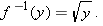
The notation leads naturally to the notation . Recall, however, that in defining a function the variable is simply a placeholder. Thus we could use other letters, including
, as the variable for the inverse function. For example, consider the function , with domain equal to the set of positive numbers, defined by the equation
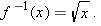
As we know, the inverse function is given by the formula
However, the inverse function could also be characterized by the formula
Other letters could also be used as the placeholder. For example, we might also characterize the inverse function by the formula
leads naturally to the notation . Recall, however, that in defining a function the variable is simply a placeholder. Thus we could use other letters, including
, as the variable for the inverse function. For example, consider the function , with domain equal to the set of positive numbers, defined by the equation
|
|
|
|

The notation for the inverse of a function (which means the inverse under composition) should not be confused with the multiplicative
inverse  . In other words,
  . However, if the exponent
  is placed anywhere other than immediately after a function symbol, then it should probably be interpreted as a multiplicative
inverse.
is placed anywhere other than immediately after a function symbol, then it should probably be interpreted as a multiplicative
inverse.
for the inverse of a function (which means the inverse under composition) should not be confused with the multiplicative
inverse . In other words, . However, if the exponent is placed anywhere other than immediately after a function symbol, then it should probably be interpreted as a multiplicative
inverse.
|
|
 .
.
|
||||||||||||||||||||||||||||||
 , with the domain of
  .
.
 .
.
 .
.
 . In other words, we must solve the equation
  . The solution to this equation is
  . Thus
  , and hence
  .
.


When dealing with real-world problems, you may want to choose the notation to reflect the context. The next example illustrates
this idea, with the use of the variable  to denote distance and
  to denote time.
to denote distance and to denote time.
|
||||||||||||||||||||||||||
 such that
  is the number of minutes since the start of the race at which you reached distance
  for a number
  .
.
| EXERCISES | |
|
|
For Exercises 1-8, check your answer by evaluating the appropriate function at your answer.
| 1 |
Suppose
 . Evaluate . Evaluate  . .
 |
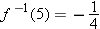
 . In other words, we need to solve the equation

 . Thus we have
  .
.
 . We have

| 2 |
Suppose
 . Evaluate . Evaluate  . .
|
| 3 |
Suppose
 . Evaluate . Evaluate  . .
|
 . In other words, we need to solve the equation

 gives the equation

 . Thus
  .
.
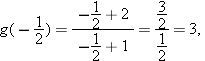
 . We have
| 4 |
Suppose
 . Evaluate . Evaluate  . .
|
| 5 |
Suppose
 . Find a formula for . . Find a formula for .
|


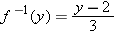
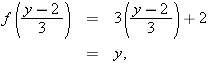
 . We have
| 6 |
Suppose
 . Find a formula for . . Find a formula for .
|
| 7 |
Suppose
 . Find a formula for . Find a formula for  . .
|
 . In other words, we need to solve the equation

 and then collecting all the terms with
 and then dividing both sides by
  gives
gives

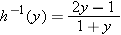
 .
.
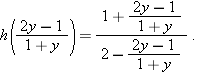
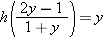 . We have

| 8 |
Suppose
 . Find a formula for . . Find a formula for .
|
| 9 |
Suppose
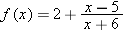 . .
|
 .
.
 .
.
 .
.
 . In other words, we need to solve the equation
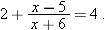
 gives the equation

 . Thus
 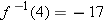 .
.

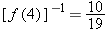 .
.
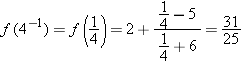
| 10 |
Suppose
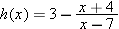 . .
|
 .
.
 .
.
 .
.
| 11 |
Suppose
 , with the domain of being the set of positive numbers. Evaluate , with the domain of being the set of positive numbers. Evaluate  . .
|
 . In other words, we need to find a positive solution to the equation



 .
.
| 12 |
Suppose
 , with the domain of being the set of positive numbers. Evaluate , with the domain of being the set of positive numbers. Evaluate  . .
|
| 13 |
Suppose
 , where the domain of , where the domain of  is the set of positive numbers. Find a formula for . is the set of positive numbers. Find a formula for .
|
 . In other words, we need to solve the equation

 from both sides of the equation above and then dividing both sides by
  and taking square roots gives

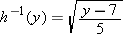
 (the restriction that
 | 14 |
Suppose
 , where the domain of is the set of positive numbers. Find a formula for . , where the domain of is the set of positive numbers. Find a formula for .
|
For each of the functions given in Exercises 15-24:
You can check your solutions to part (c) by verifying that and  (recall that is the function defined by ).
given in Exercises 15-24:
|
|
||||||||||||||||||||
and (recall that is the function defined by ).
| 15 |
 |
 makes sense for all real numbers

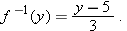
| 16 |
 |
| 17 |
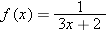 |
 makes sense except when
  . Solving this equation for
  . Thus the domain of
  .
.

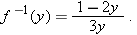
 . To solve this equation for
  , getting

 from both sides, then divide by
  , getting

 and produces a number
  leads to nonsense, as you can verify if you try to solve it for
  .
.
| 18 |
 |
| 19 |
 |
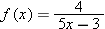
 makes sense except when
  . Thus the domain of
  .
.

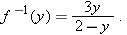
 . To solve this equation for
  , getting

 from both sides, getting

 gives
gives

 leads to nonsense, as you can verify if you try to solve it for
  .
.
| 20 |
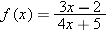 |
| 21 |
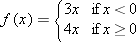 |
 , then
  , and if
  , then
  . Thus every real number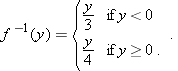
| 22 |
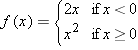 |
| 23 |
 , where the domain of equals , where the domain of equals  . .
|

 from both sides and then take square roots of both sides, getting

 because
  . Thus the range of
  .
.
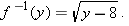
| 24 |
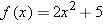 , where the domain of equals . , where the domain of equals .
|
| 25 |

Suppose
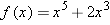 . Which of the numbers listed below equals . Which of the numbers listed below equals  ? ?
[For this particular function, it is not possible to find a formula for
.]
|

 by checking whether or not
  equals
  . Using a calculator, we find that

 .
.
 by checking whether or not
  equals
 .
.
 by checking whether or not
  equals
 .
.
| 26 |
Suppose
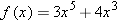 . Which of the numbers listed below equals . Which of the numbers listed below equals  ? ?
[For this particular function, it is not possible to find a formula for
.]
|

| 27 |
What is the taxable income of a single person who paid $10,000 in federal taxes for 2011?
|
 . Letting
 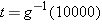 , this means that we need to solve the equation
  for
for  ,
,  , and
, and  . Because
  is between
  and
and  , this means that
  and
and  . Thus
  . Solving the equation

 . Thus a single person whose federal tax bill was $10,000 had a taxable income of $55,500.
| 28 |
What is the taxable income of a single person who paid $20,000 in federal taxes for 2011?
|
| 29 |
Suppose
 . Evaluate . Evaluate
|

 . Because
  , the quantity above equals
 | 30 |
Suppose
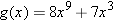 . Evaluate . Evaluate
|

| PROBLEMS | |
|
|
| 31 |
The exact number of meters in
yards is  , where is the function defined by , where is the function defined by
|

 .
.
| 32 |
The exact number of kilometers in
 miles is miles is  , where is the function defined by , where is the function defined by
|

 .
.
| 33 |
A temperature
 degrees Fahrenheit corresponds to degrees Fahrenheit corresponds to  degrees on the Kelvin temperature scale, where degrees on the Kelvin temperature scale, where
|

 .
.
 . (This is absolute zero, the lowest possible temperature, because all molecular activity stops at
 | 34 |
 ?
?
| 35 |
Suppose
is the function whose domain is the set of real numbers, with defined on this domain by the formula
Explain why
is not a one-to-one function.
|

| 36 |
Suppose
is the function whose domain is the interval  , with defined on this domain by the formula , with defined on this domain by the formula
Explain why
is not a one-to-one function.
|
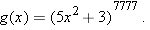
| 37 |
Show that if
is the function defined by  , where , where  , then is a one-to-one function. , then is a one-to-one function.
|
| 38 |
Show that if
is the function defined by , where , then the inverse function is defined by the formula 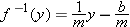 . .
|
| 39 |
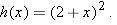
Consider the function
whose domain is the interval  , with defined on this domain by the formula , with defined on this domain by the formula
Does
have an inverse? If so, find it, along with its domain and range. If not, explain why not.
|
| 40 |
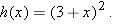
Consider the function
whose domain is the interval  , with defined on this domain by the formula , with defined on this domain by the formula
Does
have an inverse? If so, find it, along with its domain and range. If not, explain why not.
|
| 41 |
Suppose
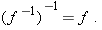
is a one-to-one function. Explain why the inverse of the inverse of equals . In other words, explain why
|
| 42 |
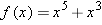
The function
defined by
is the set of real numbers). Compute for four different values of of your choice.
[For this particular function, it is not possible to find a formula for
.]
|
| 43 |
Suppose
is a function whose domain equals  and whose range equals and whose range equals  . Explain why is a one-to-one function. . Explain why is a one-to-one function.
|
| 44 |
Suppose
is a function whose domain equals and whose range equals  . Explain why is not a one-to-one function. . Explain why is not a one-to-one function.
|
| 45 |
Show that the composition of two one-to-one functions is a one-to-one function.
|
| 46 |
Give an example to show that the sum of two one-to-one functions is not necessarily a one-to-one function.
|
| 47 |
Give an example to show that the product of two one-to-one functions is not necessarily a one-to-one function.
|
| 48 |
Give an example of a function
such that the domain of and the range of both equal the set of integers, but is not a one-to-one function.
|
| 49 |
Give an example of a one-to-one function whose domain equals the set of integers and whose range equals the set of positive
integers.
|