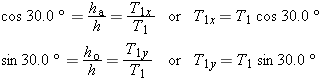
Since the acceleration points along the
x axis, there is no
y component of the acceleration

. Consequently, the sum of the
y components of the forces must be zero:
This result shows that the magnitudes of the tensions in the cables are equal,

. Since the ship accelerates along the
x direction, the sum of the
x components of the forces is not zero. The second law indicates that
Since
, we can replace the two separate tension symbols by a single symbol
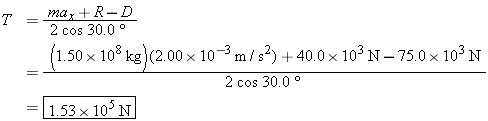
T, the magnitude of the tension. Solving for
T gives

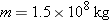 is being towed by two tugboats, as in Figure 4.30
 and
and  at equal angles of
  with respect to the tanker's axis. In addition, the tanker's engines produce a forward drive force
  , whose magnitude is
  . Moreover, the water applies an opposing force
  , whose magnitude is
  . The tanker moves forward with an acceleration that points along the tanker's axis and has a magnitude of
  . Find the magnitudes of the tensions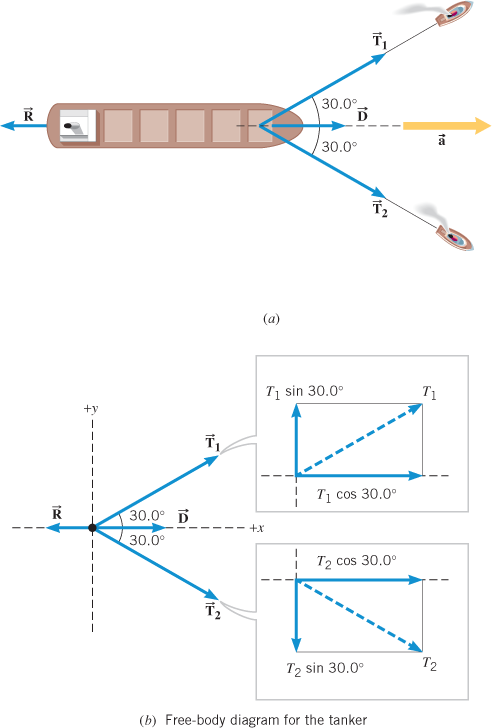
 and
and  , to obtain the magnitudes of




 and
and  , where
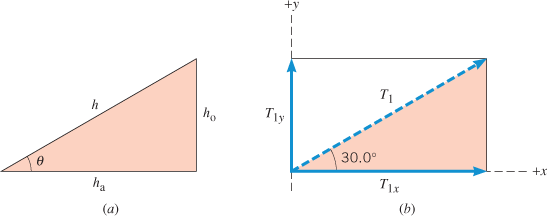
  is the length of the side of a right triangle that is opposite the angle
  ,
,  is the length of the side adjacent to the angle
  for the vector
  and
and  . Comparing the shaded triangles in Figure 4.31, we can see that
  ,
,  , and
, and  . Therefore, we have