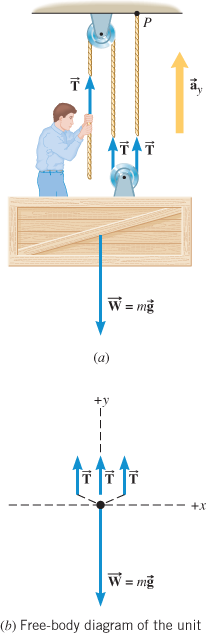
The worker and the scaffold form a single unit, on which the rope exerts a force in three places. The left end of the rope exerts an upward force

on the worker's hands. This force arises because he pulls downward with a 540-N force, and the rope exerts an oppositely directed force of equal magnitude on him, in accord with Newton's third law. Thus, the magnitude
T of the upward force is

and is the magnitude of the tension in the rope. If the masses of the rope and each pulley are negligible and if the pulleys are friction-free, the tension is transmitted undiminished along the rope. Then, a 540-N tension force
acts upward on the left side of the scaffold pulley (see part
a of the drawing). A tension force is also applied to the point
P, where the rope attaches to the roof. The roof pulls back on the rope in accord with the third law, and this pull leads to the 540-N tension force
that acts on the right side of the scaffold pulley. In addition to the three upward forces, the weight of the unit must be taken into account

. Part
b of the drawing shows the free-body diagram.

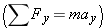 can be applied to calculate the acceleration
  :
: