| 4-1 |
Position and Displacement |
After reading this module, you should be able to …
 |
|
|
4.01
|
Draw two-dimensional and three-dimensional position vectors for a particle, indicating the components along the axes of a
coordinate system.
|
|
|
4.02
|
On a coordinate system, determine the direction and magnitude of a particle's position vector from its components, and vice
versa.
|
|
|
4.03
|
Apply the relationship between a particle's displacement vector and its initial and final position vectors. |
|
|
What Is Physics?

In this chapter we continue looking at the aspect of physics that analyzes motion, but now the motion can be in two or three
dimensions. For example, medical researchers and aeronautical engineers might concentrate on the physics of the two- and three-dimensional
turns taken by fighter pilots in dogfights because a modern high-performance jet can take a tight turn so quickly that the
pilot immediately loses consciousness. A sports engineer might focus on the physics of basketball. For example, in a free throw (where a player gets an uncontested shot at the basket from about 4.3 m), a player might employ the overhand push shot, in which the ball is pushed away from about shoulder height and then released. Or the player might use an underhand loop shot, in which the ball is brought upward from about the belt-line level and released. The first technique is the overwhelming
choice among professional players, but the legendary Rick Barry set the record for free-throw shooting with the underhand
technique.
Motion in three dimensions is not easy to understand. For example, you are probably good at driving a car along a freeway
(one-dimensional motion) but would probably have a difficult time in landing an airplane on a runway (three-dimensional motion)
without a lot of training.
In our study of two- and three-dimensional motion, we start with position and displacement.
Position and Displacement
One general way of locating a particle (or particle-like object) is with a position vector  , which is a vector that extends from a reference point (usually the origin) to the particle. In the unit-vector notation
of Module 3-2, can be written
where  ,  , and  are the vector components of and the coefficients x, y, and z are its scalar components.
The coefficients x, y, and z give the particle's location along the coordinate axes and relative to the origin; that is, the particle has the rectangular
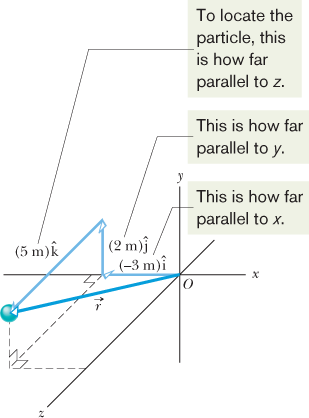
coordinates  . For instance, Fig. 4-1 shows a particle with position vector
and rectangular coordinates  . Along the x axis the particle is  from the origin, in the  direction. Along the y axis it is  from the origin, in the  direction. Along the z axis it is  from the origin, in the  direction.
As a particle moves, its position vector changes in such a way that the vector always extends to the particle from the reference
point (the origin). If the position vector changes—say, from  to  during a certain time interval—then the particle's displacement  during that time interval is
Using the unit-vector notation of Eq. 4-1, we can rewrite this displacement as
or as
where coordinates  correspond to position vector and coordinates  correspond to position vector . We can also rewrite the displacement by substituting  for  ,  for  , and  for  :
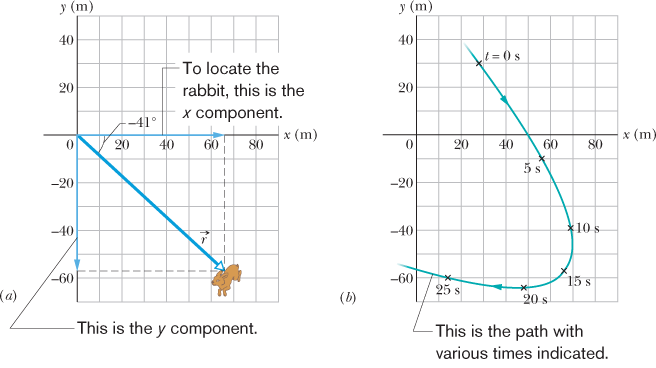
A rabbit runs across a parking lot on which a set of coordinate axes has, strangely enough, been drawn. The coordinates (meters)
of the rabbit's position as functions of time t (seconds) are given by
and
| (a) |
At  , what is the rabbit's position vector in unit-vector notation and in magnitude-angle notation?
KEY IDEA
The x and y coordinates of the rabbit's position, as given by Eqs. 4-5 and 4-6, are the scalar components of the rabbit's position vector . Let's evaluate those coordinates at the given time, and then we can use Eq. 3-6 to evaluate the magnitude and orientation of the position vector.
Calculations:
We can write
(We write  rather than because the components are functions of t, and thus is also.)
At , the scalar components are
and
so
which is drawn in Fig. 4-2a. To get the magnitude and angle of , notice that the components form the legs of a right triangle and r is the hypotenuse. So, we use Eq. 3-6:
and
Check:
Although  has the same tangent as  , the components of position vector indicate that the desired angle is  .
|
| (b) |
Graph the rabbit's path for t = 0 to  .
Graphing:
We have located the rabbit at one instant, but to see its path we need a graph. So we repeat part (a) for several values of
t and then plot the results. Figure 4-2b shows the plots for six values of t and the path connecting them.
|
|
|
|
|








 Two-dimensional position vector, rabbit run