
Experiment 7 - Preparation of Ethyl Cinnamate: A Solvent Free Wittig Reaction
Objective
To provide experience with the "Wittig Reaction", one of the most versatile reactions available for the synthesis of an alkene.Introduction
The carbon-carbon double bond, the "Functional Group" of all alkenes, is a very common functionality. It can be prepared in a variety of ways, many of which involve an "Elimination" reaction. For example, alcohols may be dehydrated under the influence of strong acid, or alkyl halides may be dehydrohalogenated in the presence of strong base. Both of these reactions have the disadvantage of employing harsh reaction conditions. In addition, the former reaction frequently results in skeletal rearrangement. A very general procedure for connecting two molecular fragments to make a new and larger molecule was announced in 1954 by the German Chemist Georg Wittig. For this discovery, Wittig was awarded the Nobel Prize in Chemistry in 1979.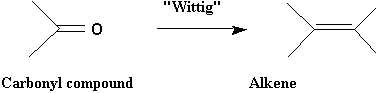
Figure 1

Figure 2

Figure 3
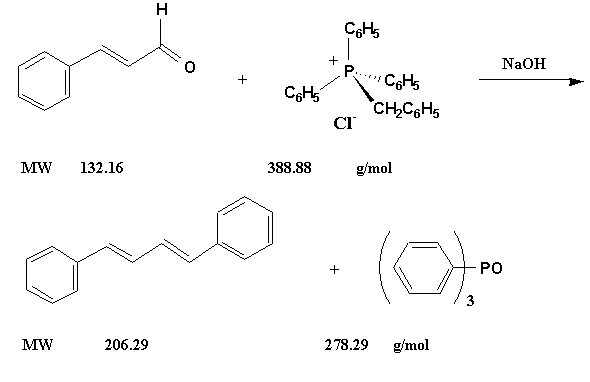
Figure 4
Equation

Figure 5
Pre-Lab
Complete the pre-lab assignment in WebAssign.Procedure
[adapted from: Kim Chi Nugyen, and Haim Weizman, J. Chem. Educ. 2007, 84(1), 119.]1
Get a DRY 5 mL conical vial.
2
In order to record the exact mass of benzaldehyde, place the vial on the balance pan, hit the tare button (this should bring the display to zero), and quickly weigh approximately 60 mg (4-5 drops) of benzaldehyde into the conical vial. [Keep the supply bottle capped except for the few seconds needed to remove a sample for weighing. Cap the conical vial to limit loss of benzaldehdye]
3
The stoichiometric ratio of benzaldehyde to (carbethoxymethylene)triphenylphosphorane is 1:1.15. Based on your mass of benzaldehyde, calculate the mass of (carbethoxymethylene)triphenylphosphorane that you will need for the reaction.
4
Weigh out and add the solid phosphorane reagent to the conical vial containing benzaldehyde.
5
Add a spin vane to the conical vial and begin to stir.
6
Stir the mixture at room temperature for 15 minutes. The solid will need to be scraped off the sides of the vial periodically.
7
Add 1.5 mL hexanes to the conical vial with a pipet and stir it to extract the product in the organic solvent.
8
Weigh a clean, dry conical vial and record the mass.
9
Filter the mixture through a cotton plugged pipet into the clean second conical vial (pipet filtration video).
10
Add another 1.5 mL hexanes to the conical vial that had the reaction mixture to extract additional product.
11
Filter the mixture through a cotton plugged pipet into the second conical vial.
12
Perform TLC analysis with the product mixture.
13
Remove the hexanes using the Smart Evaporator.
14
Once all the hexane is evaporated, remove the vial to obtain the product yield. Calculate the percent yield.
15
Obtain an IR spectrum of the product (IR video).
In-Lab Questions
Download and print the worksheet. You will use this worksheet to record your answers to the In-Lab questions.
Questions
Record the following data.- Question 1: Amount of benzaldehyde ____________________ g, ____________________ mol
- Question 2: Amount of ylide reagent ____________________ g, ____________________ mol
- Question 3: Theoretical Yield of product ____________________ mol, ____________________ g
- Question 4: Actual Yield ______________________
- Question 5: Percentage Yield ______________________
- Question 6: Record your calculations.
- Question 7: Calculate the Rf values of the starting material (benzaldehyde) and product (ethyl cinnamate) from the TLC
- Question 8: List the characteristic IR absorption frequencies observed in ethyl cinnamate and assign each peak to its corresponding functional group.
- Question 9: Draw the mechanism for the reaction.