Potential Energy
Topics and Files
Mechanics Topics
-
Gravitational potential energy
-
Elastic potential energy, Hooke's Law
Capstone Files
-
26A Discover GPE v2.cap
-
28 Spring Energy.cap
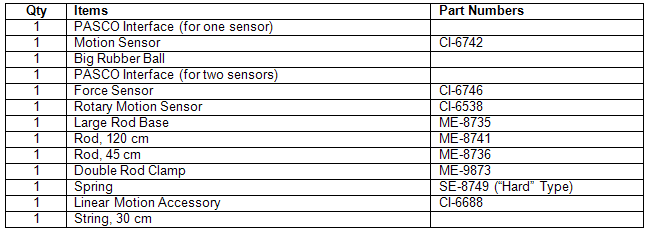
Equipment List
Introduction
This lab has two parts.
The purpose of Experiment 1 is to investigate the relationship between gravitational potential energy and the distance from a reference point.
Use the motion sensor to measure the motion of a ball as it is moved up and down relative to the sensor. Use Capstone to record and display the motion. Compare the position of the ball to the value of its gravitational potential energy.
The purpose of Experiment 2 is to measure the energy stored in a stretched spring. Use Hooke's Law to determine the spring constant of the spring.
Use a force sensor to measure the force applied to a spring and a rotary motion sensor to measure the stretch of the spring. Use Capstone to record and display the force and the stretch. Use the graph display of force and stretch to determine the spring constant for the spring and the amount of work done to stretch the spring. Calculate the elastic potential energy and compare it to the work.
Background
Gravitational potential energy is the energy of an object due to its vertical position relative to a reference point (such as the surface of the Earth). When an object is lifted a certain vertical distance, it gains gravitational potential energy (GPE). How much it has depends on its weight (mg) and the vertical distance. As the object changes its position, its gravitational potential energy changes.
where m is the mass, g is the acceleration due to gravity, and h is the height.
A spring exerts a 'restoring force' when it is stretched (or compressed). The spring's force, F, depends on the spring constant, k, and the amount of stretch, x. Hooke's Law describes the 'restoring force' exerted by the spring as F = −kx.
The negative sign indicates that the force acts opposite to the direction of the stretch (or compression).
When work is done to stretch (or compress) a spring, the spring gains elastic potential energy (EPE). The amount of EPE depends on the amount of work done. Work is the average force applied times the distance over which it is applied. For a spring that exerts a stronger and stronger restoring force as it is stretched, the magnitude of the average force is This means that the formula for the elastic potential energy is as follows.