SMILES
SMILES, which stands for "Simplified Molecular Input Line Entry System", can be used to describe the structure of chemical substances as a text string.
Many chemical drawing programs can produce and understand SMILES, including the Marvin chemical drawing tool used in WebAssign content.
- Use the Import feature to copy SMILES into Marvin.
- Use the Export feature to copy SMILES from Marvin.
You may also find SMILES as part of a figure caption description of a chemical structure, as well as a chemical formula. Both forms are presented as additional information to clarify what the chemical drawing represents. Read on!
Understanding SMILES
SMILES notation is relatively easy to learn: "C" means carbon, "H" means hydrogen, "O" means oxygen, and so on, as defined in the periodic table. Single bonds are implied (common in condensed chemical formulas), double bonds are represented by "=", and triple bonds are represented by "#". Thus, CO2 is "O=C=O". There are a few more nuances, as we'll show below.
Simple Atoms
Representative elements (with the exception of hydrogen) can be used as they appear on the periodic table. All other elements should be enclosed in square brackets.
- C, N, O, P, S, F, Cl, Br, I
- Lowercase "c" and "n" are used to indicate aromatic C and N atoms, respectively.
- [H] is used when explicitly shown, but omitted when implied.
- H would be present in "complete" or "Lewis" structures.
- H would be omitted in "condensed" or "skeleton" structures.
- In some structures, the H may appear with the heavier atom attached to it, e.g., [CH3].
- [Fe], [Co], [Ni], etc.
- Generic atoms (or "any"-type atoms) are identified with [A] or *.
Simple Bonds
Single bonds are implied. Double and triple bonds are explicit.
| SMILES | Structure |
|---|---|
| CC |

two C's connected with a straight line
|
| C=C |

two C's connected with a double parallel line
|
| C#C |

two C's connected with a triple parallel line
|
Advanced Atom Annotation Techniques
Atomic Charges
For largely historical reasons, atomic charges take a somewhat odd form and appear with the atom symbol in between square brackets.
| SMILES | Structure |
|---|---|
| [Na+] | Na+ |
| [Ca++] | Ca2+ |
| [Sc+3] | Sc3+ |
| [F-] | F− |
| [S--] | S2− |
| [P-3] | P3− |
Atom Labels
In some cases, it may be beneficial to label (a.k.a. map or mark) one or more atoms in a structure for emphasis. In SMILES this is accomplished by adding a colon and an integer to the atom specification.
| SMILES | Structure |
|---|---|
| [CH2:1]=[CH:2]CC |
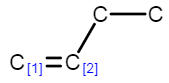
a linear sequence: a C marked [1] connected with a double bond to a C marked [2], further connected to two C's, each with a single-bond
|
Isotopes
Occasionally you will encounter structures that are isotopically labeled. Isotopes are written in AX format inside square brackets.
| SMILES | Structure |
|---|---|
| [3H]Br |
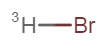
a linear sequence: an H atom marked 3H, connected to a Br atom by a single bond
|
Advanced Bond Annotation Techniques
Branching
Not all chemical structures consist of simple chains of atoms. So-called branching (using parentheses) is used to define groups or substitution patterns, connected to the main chain.
| SMILES | Structure |
|---|---|
| CC(C)CC |
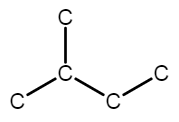
a branched sequence containing only single bonds: a C atom connected to a branching C atom; the branching atom contains 1 C atom in the first branch and 2 sequential C atoms in the second branch
|
| CC(=O)OC |
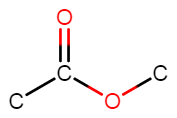
a branched sequence: a C atom connected to a branching C atom; the branching atom contains 1 double-bonded O atom in the first branch and a single-bonded O atom connected to a further single-bonded C atom in the second branch
|
Cyclic Structures
Cyclic structures are represented by designating ring opening (or closure) bonds by a digit immediately following the atomic symbol at each ring closure.
| SMILES | Structure |
|---|---|
| C1CCCCC1 |
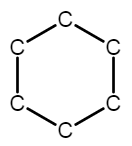
a six-membered cyclic structure containing only single-bonded C atoms
|
| C1=CC=CC=C1 |
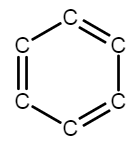
a six-membered cyclic structure containing alternating single-bonded and double-bonded C atoms
|
| c1ccccc1 |
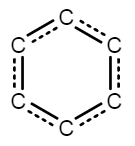
a six-membered cyclic structure containing only aromatically-bonded C atoms
|
| C1CCC(C1)C2CCCC2 |
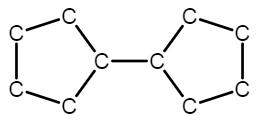
Two five-membered cyclic structures are connected by a single bond. Each cycle contains only single-bonded C atoms.
|
| C1CCC2(C1)CCCC2 |
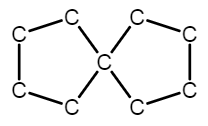
Two five-membered cyclic structures are connected to each other through a shared atom. Each cycle contains only single-bonded C atoms.
|
| C1CC2CCCC2C1 |
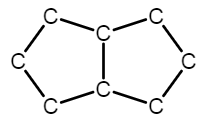
Two five-membered cyclic structures are connected to each other through a shared bond. Each cycle contains only single-bonded C atoms.
|
Explicit, Implicit, and Implied Hydrogen atoms
Chemists have three principal ways to indicate how many hydrogen atoms are connected to any one carbon atom. This is due to the abundance of hydrogen atoms whenever carbon atoms are present.
- Explicit hydrogen atoms: all hydrogen atoms must be shown. Amongst others, you will find this in so-called "Lewis structures". E.g., the molecule ethane with the molecular formula C2H6 may be written as [H]C([H])([H])C([H])([H])[H].
- Implicit hydrogen atoms: only the hydrogen atom count is given, much in the same way as so-called "condensed formulas". E.g., the condensed formula CH3CH3 for ethane can be written in SMILES as [CH3][CH3].
- Implied hydrogen atoms are simply not shown at all. This form is also known as a "skeleton structure" or "line-bond drawing". E.g., the molecule ethane is simply CC. It is then assumed that all missing atoms, i.e. open valences, are hydrogen atoms.
This concept is oftentimes extended to non-carbon atoms. For instance the hydroxy group may be written as O[H], [OH], or simply as O, depending on the context.
Stereochemistry
Stereochemistry is indicated with slashes for E/Z (cis/trans) bonds and @ symbols for R/S stereocenters.
The relative orientation of the slashes indicates the orientation around the double bond.
- \=\ has the ends of the slashes pointing in opposite directions and is thus E (trans).
- \=/ has the ends of the slashes pointing in the same direction and is thus Z (cis).
The stereochemistry around chiral atoms is relative.
- @ is a counter-clockwise symbol (evolving from the center) and is thus S.
- @@ would then be a double-counter-clockwise symbol and is thus R.
| SMILES | Structure |
|---|---|
| C\C=C\C |
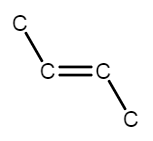
a linear sequence: 2 peripheral C atoms, each connected to 2 double-bonded C atoms; the peripheral atoms are positioned on opposite sides of the double bond
|
| C\C=C/C |
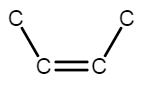
a linear sequence: 2 peripheral C atoms, each connected to 2 double-bonded C atoms; the peripheral atoms are positioned on the same side of the double bond
|
| [H][C@](F)(Cl)Br |
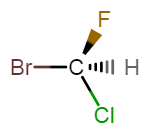
4 atoms arranged around a central atom with implied directionality: the central atom is a C atom; a Br atom left of center, and a Cl atom below center form a plane with the central atom; an H atom lies behind the plane, and an F atom lies in front of the plane
|
| [H][C@@](F)(Cl)Br |
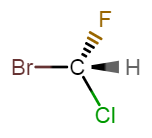
4 atoms arranged around a central atom with implied directionality: the central atom is a C atom; a Br atom left of center, and a Cl atom below center form a plane with the central atom; an H atom lies in front of the plane, and an F atom lies behind the plane
|
Multiple Structures
When multiple structures are present in one drawing, the SMILES are separated from each other with a period. It is common to find this in salts, isomeric drawings, and reactions.
| SMILES | Structure |
|---|---|
| [Na+].[F-] | Na+ F− |
| C\C=C\C.C\C=C/C |
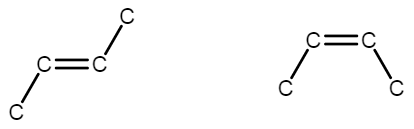
a composite structure: 2 isomers of the CC=CC structure are shown; 1 with both ends on the same side of the double bond; and 1 with the ends on opposite sides
|
Reactions
Reactions are by definition composed of reactants and products. In SMILES, reactants appear to the left of a >> and products appear to the right of it. There is no choice of arrows. On rare occasions (such as when a catalyst is present), the catalyst is placed between the > symbols.
| SMILES | Structure |
|---|---|
| C\C=C\C.[H][H]>>CCCC |
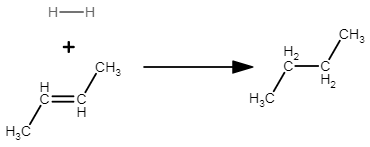
a reaction: C\C=C\C reacts with HH to form CCCC
|
| [H][H].CC(C)=C>[Pt]>CC(C)C |
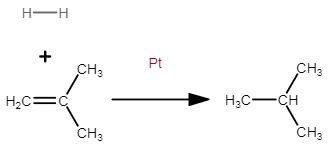
a reaction: C=C(C)C reacts with HH in the presence of Pt to form CC(C)C
|
Note that in some drawing modes, H atoms appear on the drawing canvas that are not present in the SMILES code. This is normal and anticipated behavior for many chemical drawing tools. These H atoms are often called "implied hydrogen atoms" because the SMILES code implies that they should be there to fulfill valence rules.
Extended Properties
Decorations (such as lone pairs, radical electrons, and a few other items) are not intrinsic parts of chemical structures, but they are used to highlight certain features. These features cannot be captured using standard SMILES, but can be captured in so-called extended SMILES, where they are placed between vertical bars. Atoms are counted from the left of the SMILES starting at position 0.
- Lone pairs are written as lp, followed by the atom it applies to, which is followed by the number of lone pairs present.
- Radical electrons are written as ^, followed by their spin state and the atom it applies to.
| SMILES | Structure |
|---|---|
| [Li] |^1:0| |

a Li atom with a single dot placed next to it
|
| [Be] |^2:0| |

a Be atom with two single dots placed next to it at opposite ends
|
| [B] |^7:0| |

a B atom with three single dots placed next to it at cardinal positions
|
| Unfortunately, the tetravalent state cannot be described in SMILES. |

a C atom with four single dots placed next to it at cardinal positions
|
| [H]N([H])[H] |lp:1:1| |
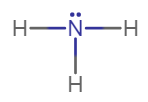
The molecule NH3 is shown with a double-dot placed next to the N atom. All atoms are connected by single bonds.
|
| [H]O[H] |lp:1:2| |
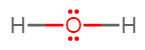
The molecule H2O is shown with two double-dots placed next to the O atom. All atoms are connected by single bonds.
|
| C#N |lp:0:1,1:1| |
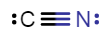
The CN− icon is shown with a single double-dot placed next to each atom. The atoms are connected by a triple bond.
|
| [N]=O |lp:0:1,1:2,^1:0| |
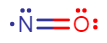
The NO molecule is shown with a single-dot and a double-dot placed next to the N atom and 2 double-dots placed next to the O atom. The atoms are connected by a double-bond.
|
Mechanism Illustrations
Drawings used to show mechanistic movement of electrons during a chemical transformation are so-called process functions rather than state functions. While SMILES are adept at capturing states, they are intrinsically unsuitable to capture processes. The beginning- and end-state may be presented as SMILES, but electron-flow arrows can only be described in words for figure captions and in Chemical Markup Language when interacting with the Marvin drawing tool.
Further Reading
While this document describes features that are fairly common in general chemistry, biochemistry, and organic chemistry, it is by no means comprehensive. More information may be obtained from the following sources.