Interpreting the Standard Deviation for Bell-Shaped Curves: The Empirical Rule
Once you know the mean and standard deviation for a bell-shaped curve, you can also determine the approximate proportion of the data that will fall into any specified interval. Here are some useful benchmarks.
- 68% of the values fall within 1 standard deviation of the mean in either direction.
- 95% of the values fall within 2 standard deviations of the mean in either direction.
- 99.7% of the values fall within 3 standard deviations of the mean in either direction.
Note: A small percentage, about 0.3%, falls farther than 3 standard deviations from the mean.
Combining the Empirical Rule with knowledge that bell-shaped variables are symmetric allows the "tail" ranges to be specified as well. The first statement of the Empirical Rule implies that about 32% of the values fall farther than 1 standard deviation from the mean in either direction. Due to the symmetry of the bell-shaped curve, we can say that about 16% of the values fall more than 1 standard deviation below the mean and about 16% fall more than 1 standard deviation above the mean. Similarly, about 2.5% fall more than 2 standard deviations below the mean and about 2.5% fall more than 2 standard deviations above the mean.
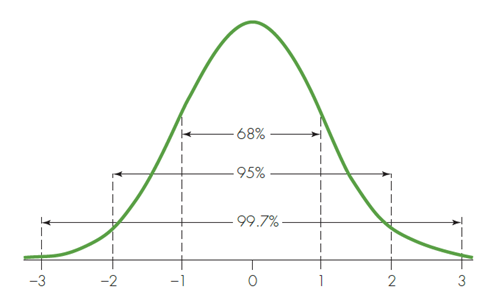
A graph with a bell-shaped, continuous, and symmetric curve above the horizontal axis is given.
- There are 7 equally spaced labels on the axis; from left to right they are: , , , , , , and .
- The curve enters the viewing window just above the axis at , reaches a peak at , and exits the viewing window just above the axis at .
- A dashed vertical line is drawn above the numbers , , , , , and .
- "68%" is written on the line segment that extends from the dashed vertical line over to the dashed vertical line over .
- "95%" is written on The line segment that extends from the dashed vertical line over to the dashed vertical line over .
- "99.7%" is written on the line segment that extends from the dashed vertical line over to the dashed vertical line over .
Identifying Possible Outliers
One guideline sometimes used to identify outliers is that data values more than 2 standard deviations in either direction from the mean are possible outliers. As an example, suppose that a sample of body temperatures (Fahrenheit) for people who are not ill has a mean of 98.3 degrees and a standard deviation of 0.5 degrees. For an individual whose body temperature is measured as 97.0 degrees, the individual’s temperature is 2.6 standard deviations below the mean, so it is a possible outlier.